After the fire

On Sunday, at dawn, I’d woken to the smell of smoke in the air. Not much, just a rasping at the back of the throat. Enough to know it was there, though not enough to be an immediate concern. Yet it did mean that the wind had changed. Which meant that there was a real risk that it could flare up all over again.
Two days later. After the fire.
Back on Friday morning - January 9th - it was already obvious that the danger was there. ‘Catastrophic Fire Danger’, to be precise. Out here, that’s not hyperbole, but a formal term in weather-forecasts: it means that if a bushfire does start, it’ll likely be almost impossible to stop. Even at dawn it was already stupidly hot, expected to go up well into the forties (above 110˚F) by the middle of the day, and the wind was blasting a full gale - unusually so, for here. Not good: not in this season, in this landscape.
For me personally, the risk was small: I live in the middle of boring suburbia. Even so (as residents of the Palisades and Altadena areas of greater Los Angeles now know all too well), it was still a risk I needed to respect: I got my emergency-evacuation bags ready, confirmed the location of the local ‘Bushfire Place of Last Resort’, and got my essential papers out of storage. I knew that I could get out of here within a matter of minutes if the warning came.
Yet the risk was not small at all for my colleague and co-author Slade. Unlike me, he lives right out in open country, in the gentle slope beneath the mountain shown in this photograph that I’d taken for a friend after I’d visited Slade just a couple of days earlier.
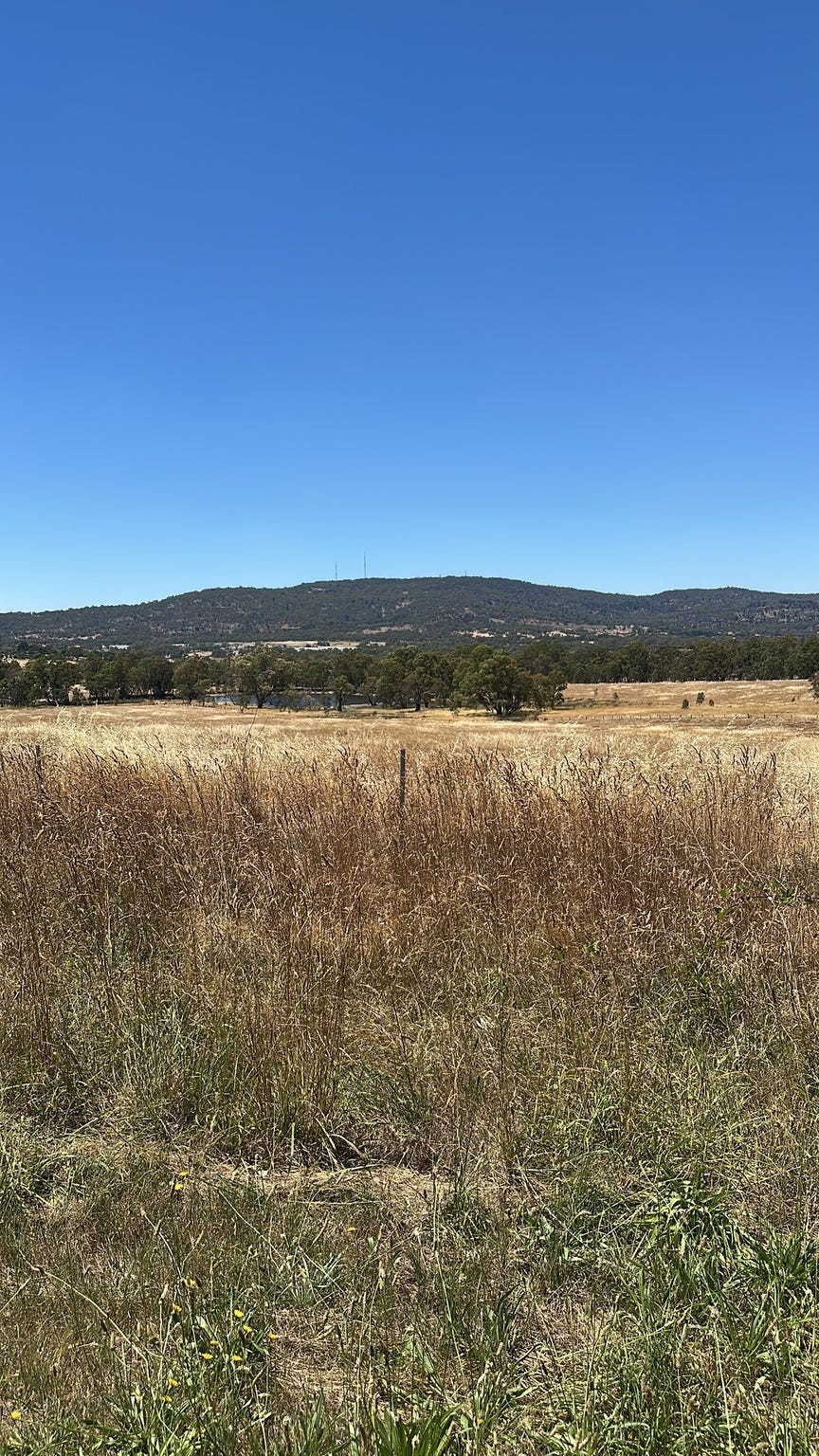
Four days later - two days after the fire - the picture was very different. Fickle as always, the blaze had jumped much of the grassland here, but had blasted the treeline, and kept on going. The mountain, you’ll note, was still on fire - and still is, at this current date.
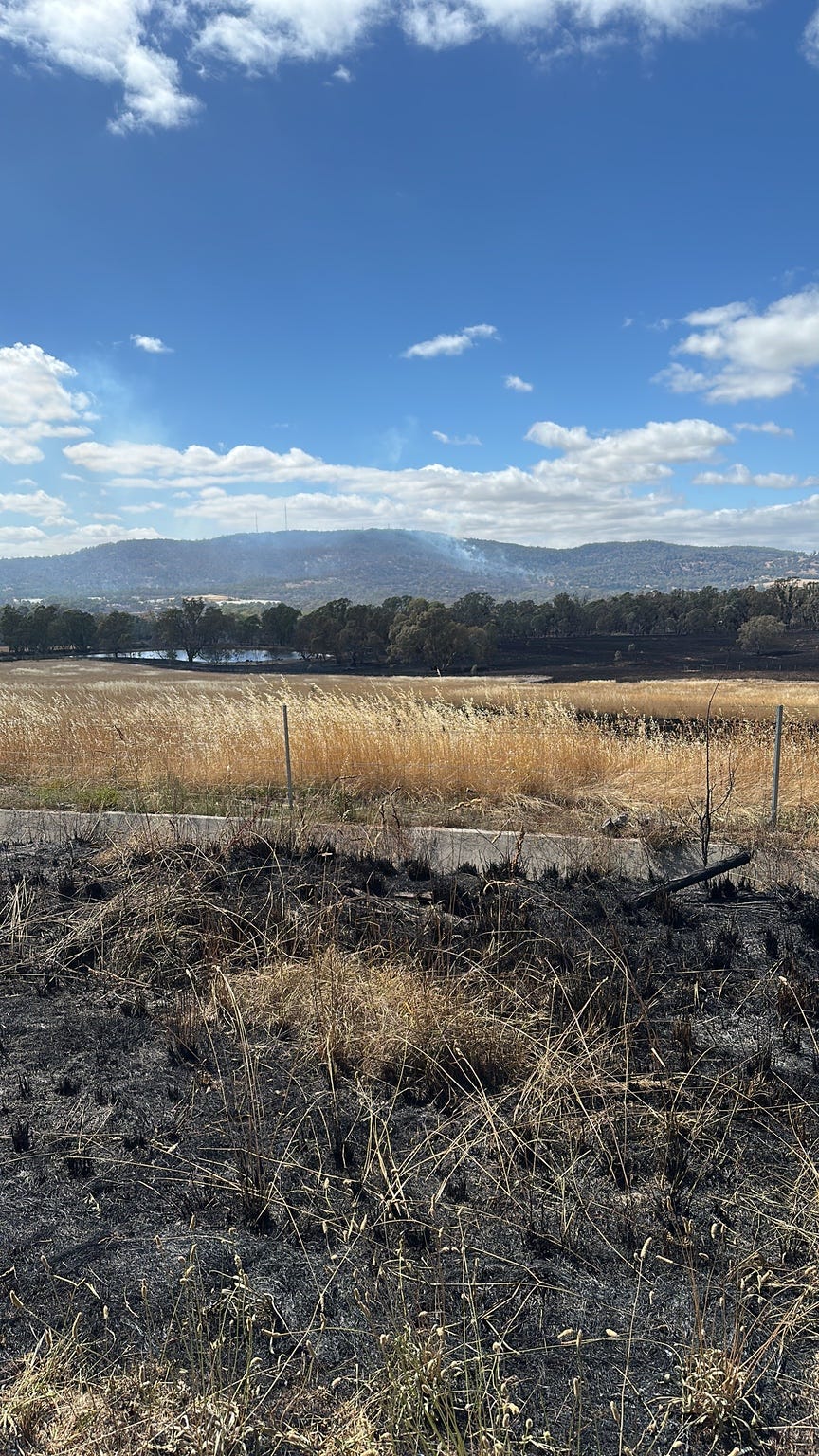
Small changes? That’s not a small change, after the fire…
Let’s put in a bit of a timeline here.
On Friday morning, I knew that Slade was going in to Melbourne for a medical operation. I’d sent him a ‘best wishes’ text-message at around 8am. It wasn’t major, but I’d expected him to have to stay in overnight. He’d sent me a thanks in reply, and all seemed well. An ordinary day.
Given the fire-danger warning, I’d been checking the state’s emergency app every half-hour. Somewhen around 4:30pm, I noticed that a bushfire-flag had appeared for Ravenswood. That’s quite some distance north from Slade’s place, so I wasn’t worried at first. A moment later, though, the map updated to show that the fire was actually much further south than I’d thought, and a warning had been declared for the region that included Slade’s place. Now I really was worried: I needed to do something, fast…
I didn’t know the phone number for Slade’s wife, who I’d assumed would still be at the house - and all on her own there. After flailing around trying to find her number, I called another friend, Helena, who lived closer to Slade’s place - but no answer from her either, which was worryingly unusual. At around 5pm, I sent an email to Slade’s wife, offering support - but the emergency-app showed that there were already road-blocks in place by then, so I wouldn’t have been able to get through.
Fifteen agonising minutes later, I had a text-message from Helena, telling me that she was at Slade’s place, that Slade had fortunately been able to get back from Melbourne in time, but the situation was looking more and more dangerous: “ominous”, “smoky”, and more. And it was already too late to leave - too dangerous, with fires all around. They’d have to stay where they were, and hope that they could somehow ride out the flames if the the fire came.
That was the last message. Not good. Not good at all.
And there was nothing I could do to help. All I could do was sit and wait and worry and worry and worry, watching the ‘building-on-fire’ flags pop up on the emergency-app’s map all around Slade’s place, again and again and again.
At last, at last, at around 7:30pm, a text-message came through. They were safe - they’d sheltered underwater in the swimming-pool as the 500˚C flames of the firefront passed overhead. Some of the farm-sheds had burnt down, but the house had survived. The dogs and sheep had all survived, too. And she attached this brief video, timestamped just half an hour earlier:
(Video: © 2026 Helena Rea-Tanner)
There’s a lot packed into the 13 seconds of that video. At the start, you’ll see the grass still smoking where the intentional ‘green-belt’ had succeeded in preventing the fire from reaching the house; in the background, you’ll see trees and sheds still on fire. Then, you’ll see the white SCUBA-diving tanks beside the swimming-pool, that they’d used to help them breathe while the firefront sucked all the oxygen from the air. Further on, you’ll hear, and then see, the farm’s mobile fire-fighting rig in action against the burning trees; at the end, there’s a gunshot-like crack as yet another huge tree-branch falls to the ground somewhere in the forest.
And that seemed to be it. A sigh of relief. After the fire, at last.
Except that it wasn’t over. Not yet.
I continued checking the emergency app. Two hours later, at around 9:30pm, a new ‘building-on-fire’ flag appeared - positioned exactly at Slade’s place. I tried desperately to get in touch, but by this point the fire had reached the cell-phone towers on the mountain, and even text-messages couldn’t get through. Once again, I worried and worried, but there, again, there was nothing I could do. Eventually, I went to bed, worried beyond belief.
And then, in the morning, the worries became even worse. The local TV station had said that a man had died in the fire, not from the fire itself, but from a heart-attack while fighting the fire. A man of Slade’s age. And Slade had had an operation just that morning…. - was it he that had died?
No way to know: cell-service was still down out there.
Frantic…
It wasn’t until around 9am that a text-message from Helena popped up, timestamped from just before midnight the previous day: all had indeed been well back then, everything safe. Good news from that time at least - though not necessarily so for that morning...
I’d sent a reply, straight away, asking for more details. But it seemed that the cell-tower was down again, because the next message didn’t come through until late that afternoon. I finally learned that Slade was fine, and that the ‘building-on-fire’ flag had actually been for the next house along the road, which sadly couldn’t be saved - though their two horses had been rescued, without harm.
The fire was over; the long clean-up could begin…
The roads were closed for the whole of the Saturday, but were opened again on the following day. At last I was able to visit them, and see what I could do to help.
At that time, two days after the fire, the power was still down. Literally.
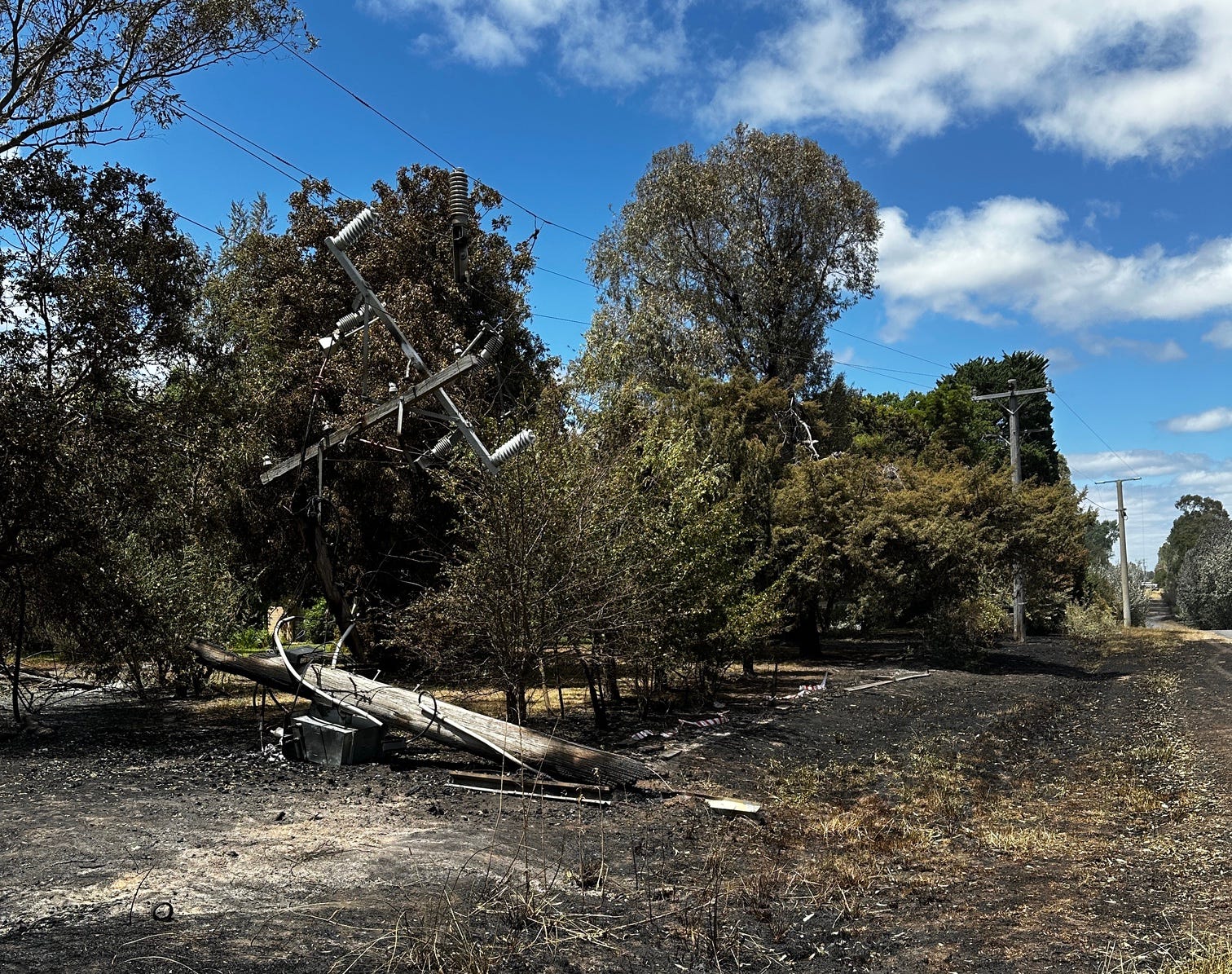
Yet we could see how the fire-line had stopped at the edge of the chicken-pen, starved of fuel because the chickens had already pecked the pen clear of anything that could burn.
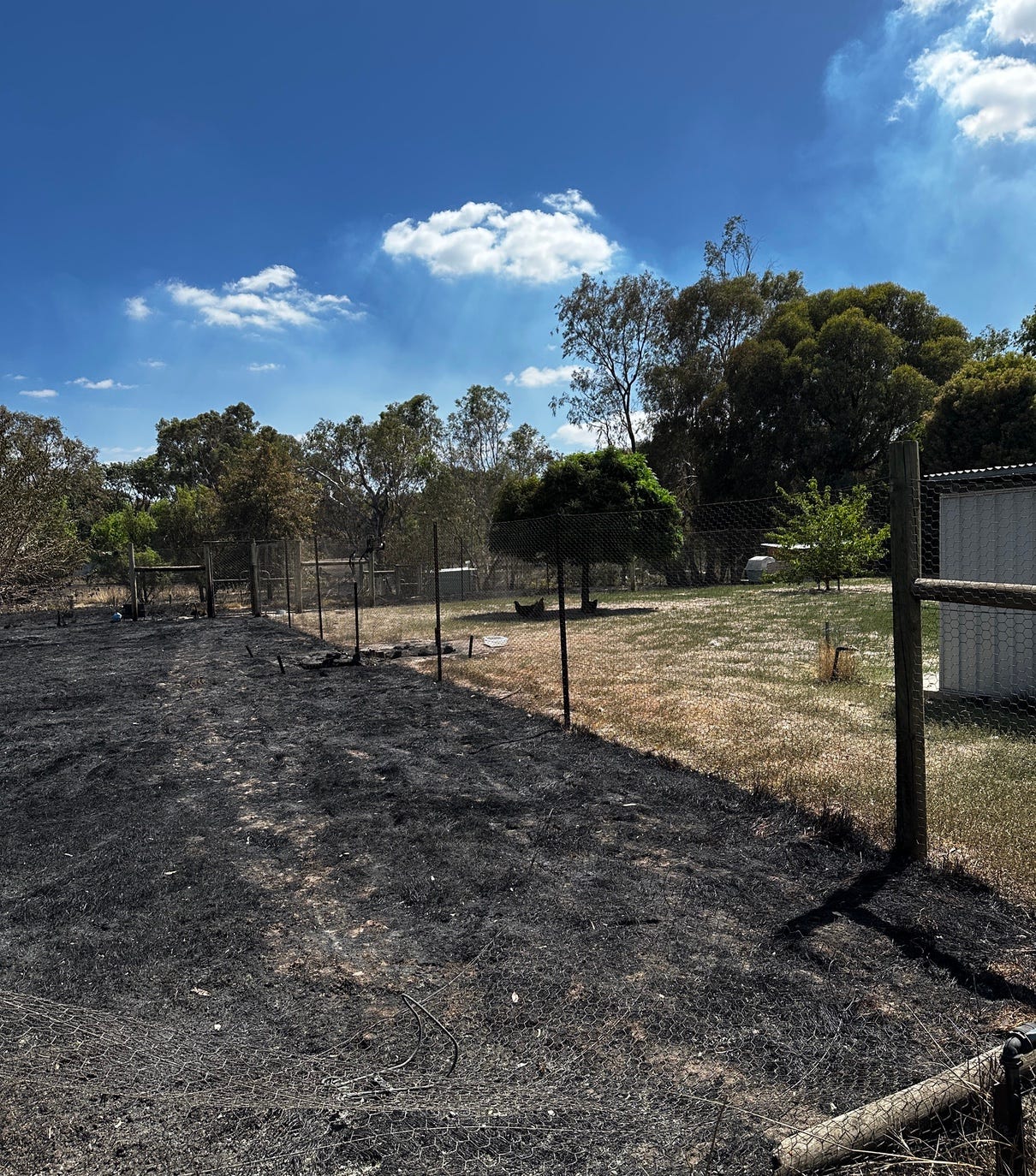
There were still firefighting-helicopters growling overhead, and fire-crews mopping up along the road. Yet looking around, it became clear how that ‘green-belt’ had saved the farm’s core.
And despite all the damage and destruction, the life of the farm must continue on. Over by the gate that opened into the one usable paddock that still remained, Slade was bottle-feeding a ‘poddy’, a motherless lamb whose mother had died in childbirth a few weeks before.
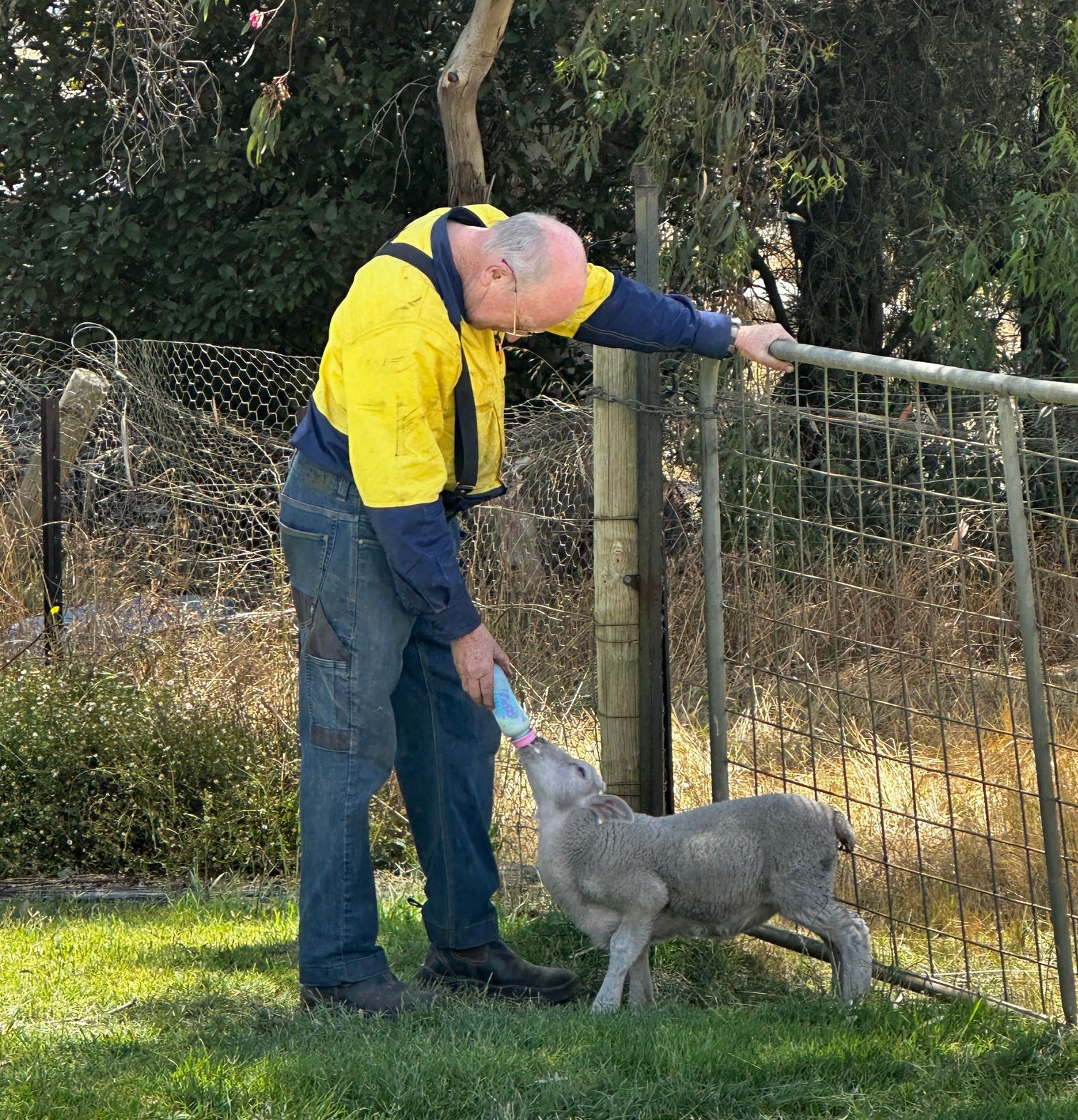
First steps on the long road to recovery, after the fire.
There’s plenty more to say on this, about lessons-learned and all that, but it’s best that I stop here for now, and leave the rest until some later time.
Thank you all once more.
x
I'm so glad to hear that everyone is okay, Tom. ❤️
Hi team. Finally, a chance for me to comment. It's hard to put into words the experience we had in going through this fire. For a start, let me make it clear that riding a fire like this one out in the swimming pool is NOT a recommended action. However, with the speed of the fire, we ran out of options very quickly. The differentiating factor is that, as scuba divers, we have an air option that most do not have. Fires like this one remove the available oxygen from the air as they pass through.
We have a long and costly repair bill in front of us. 98% of all our pastures were destroyed, and all of the fences except the lambing paddock were destroyed.
For us, the biggest lesson is related to the green belt, which we spent many years developing. As the fire raced towards us in the pool, it hit the green grass about 5 metres in front of us and promptly collapsed in that area. The most amazing thing, though, is the front of the house. We have a deep green belt at the front of the house (around 30m deep). Very few native plants are in this area. Natives tend to be high in oils and/or high in dead plant material. My planting intentions were set by some work that was done following a previous severe fire season. It was found that oak stands carried the fire out of the canopy (the most dangerous place for it to be) and dropped it into the high-humidity zone beneath the trees. The principle, applied, saved our house and the main sheds, which fell into the protected zone.
So now - into the rebuild. Bit by bit and with assistance from an amazing organisation called BlazeAid.