Back in action, at last

Yes, it’s been a long gap, and again I apologise. But I am still here, and I am still committed to this Small Changes project (or whatever it is).
Simplest way to put it: Long-COVID ain’t fun. (There are coarser and more accurate ways to put it, but that’ll do…) I’ve learned the hard way that it’s closely related to chronic-fatigue syndrome, which certainly makes sense. Not fun. Definitely not fun…
I contracted COVID way back at Christmas 2023, and at first it seemed to be over and done with in a matter of days. It wasn’t, unfortunately: in fact that was just the start. I could function, physically, sort-of, well enough, but I couldn’t think straight, couldn’t assemble thoughts, and could barely write at all. As a writer by trade, that was a professional disaster. At its worst, around April or May last year, my productivity was probably well below 20%. It took a full year to claw it back up to 30%, with publisher-deadlines zipping past at a terrifying rate.
Right now I’m perhaps back to about 50% of where I was before COVID. But least I can still work, and with the book out of the way for now (more on that in a moment), I can now focus my attention back to the use of those ideas and practices in the kinds of large-scale issues that we all face.
Back in action, at last.
The book. Ah yes, the book.
It’s titled ‘Doing Enterprise-Architecture’. If things stick to schedule, it’ll be published by Springer/Apress around late October or early November this year. For reference, here’s the book-cover:
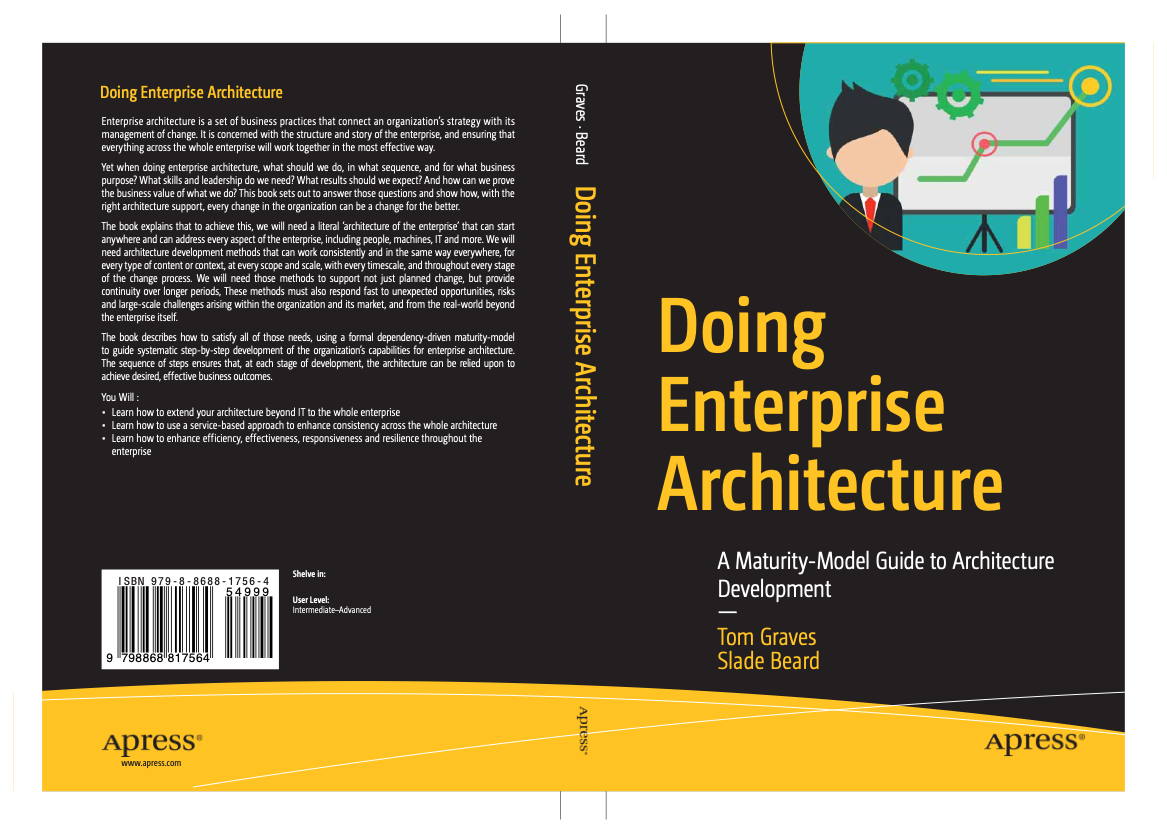
It’s a new, much-updated edition of a previous book of mine from 2009. This time, as you’ll see from the cover, it’s co-authored with enterprise-architect and sustainability-architect Slade Beard. (The Technical Review was provided by Rajeev Arora, who is a subscriber here - thanks, Rajeev!)
Why this book may matter to you here is that it’s about guiding change-work within the enterprise as a whole. Not just ‘the easy bit’ of IT-stuff for big corporations, as in classic ‘enterprise’-architecture, but for everything in the shared-enterprise as a human construct. The enterprise as a human purpose that, because everyone is connected with everyone else in some way or other, must ultimately benefit everyone and everything in the wider world.
I’ll write more on that as we get closer to the book’s release. For now, though, a quick summary would be that it’s about how to keep everything linked together across every aspect of the enterprise, because “things work better when they work together, on purpose”.
It’s built around context-neutral methods that work the same way everywhere, for every type of content or context, every scope and scale, every stage of the change-cycle and lifecycle. And because those methods work the same way everywhere, that in turn gives us a practical way to enact this Substack’s guiding-principle of “practice on the small changes to get ready for the big ones”.
And yes, there are a lot of changes going on everywhere around us right now. Few of them seem good: there’s no doubt at all that right now we’re going backwards fast on climate-change, social change, economic equity, and so much more. So much so that it’s all too easy to fall back into feelings of hopelessness, helplessness, doom and gloom…
Yet the reality is that there are alternatives to the technofeudal dystopias that might seem to be all that’s on offer right now. We can create a better, more viable, more thrivable world for everyone. The catch is that if we allow ourselves to drown in any of that everywhere-pervasive gloom and doom, it’ll cripple us, cripple our ability to make useful changes towards that better world. To break free of the dystopian trap, we need to reframe our view of the world towards optimistic realism, or realistic optimism, as typified by genres such as Solarpunk (video) and Hopepunk (video). And in turn, we need to connect those somewhat-abstract ideals with real-world, whole-of-context practice, such as those outlined in permaculture:
“Permaculture is a philosophy of working with, rather than against nature; of protracted and thoughtful observation rather than protracted and thoughtless labor.”
That’s where the idea of small changes comes into the picture. Right now, those big changes that we need are far too big to face, as big-changes. But by building practice on the small changes, we develop our ability to tackle the big ones. Act local, think global; act local, aware of the global; act local, be global.
I’ve been away from here for way too long. I want to get back into practical action, back into regular posts here, at least once a week if I can (though given the ongoing unjoys of Long COVID, it may still take me a while to get there…). I also want to experiment with video, with more interactive ways of working with you. A lot we can do, together.
If you’re willing to share some of the costs for creating videos and the like, I’ll also enable paid-subscriptions here - that would definitely help me do this! Perhaps let me know via comments or messages here what you would like me to do on that, and what would bring most value to you from a paid-subscription here.
There’s a lot for us do - a lot we can do, too. Let’s explore it here together, in that spirit of realistic optimism, optimistic realism, small changes everywhere, one small, practical, everyday, step at a time.
Back into action, at last.
Welcome back Tom congratulations on the book. I look forward to conversing with you soon as you are able.
Welcome back Tom! Many congratulations on your new book. Excited to read your weekly writeups (if possible).