A sobering experience

Last week, I had to ferry a friend back to her home in Castlemaine, after she’d returned my campervan that she’d been borrowing for a while. (The tale of the campervan is one I also need to tell, but that’s a different story for another time.)
Castlemaine is a few miles beyond Harcourt - the small town where my colleague Slade lives, and which had been hit hard by bushfire just a few weeks ago, as I’d described in the previous post ‘After the fire’. As I may have mentioned here before, I’d lived there myself a year ago, on the other side of town from Slade’s place. It’d only been a short-term rental - six months, to give me time to find a more permanent place to live after my previous rental place in Eaglehawk had been sold under me by the landlord.
That house on Mills Road in Harcourt soon became a good home for me, somewhere to sort out my thoughts and my things, and a solid base from which to do the house-search and to work with Slade on our ‘Doing Enterprise-Architecture’ book. By the time time the lease ended, I’d found this current place back in Eaglehawk, and moved in to here just over a year ago now, just before Christmas 2024. In that point, my time of living in Harcourt had come to an end.
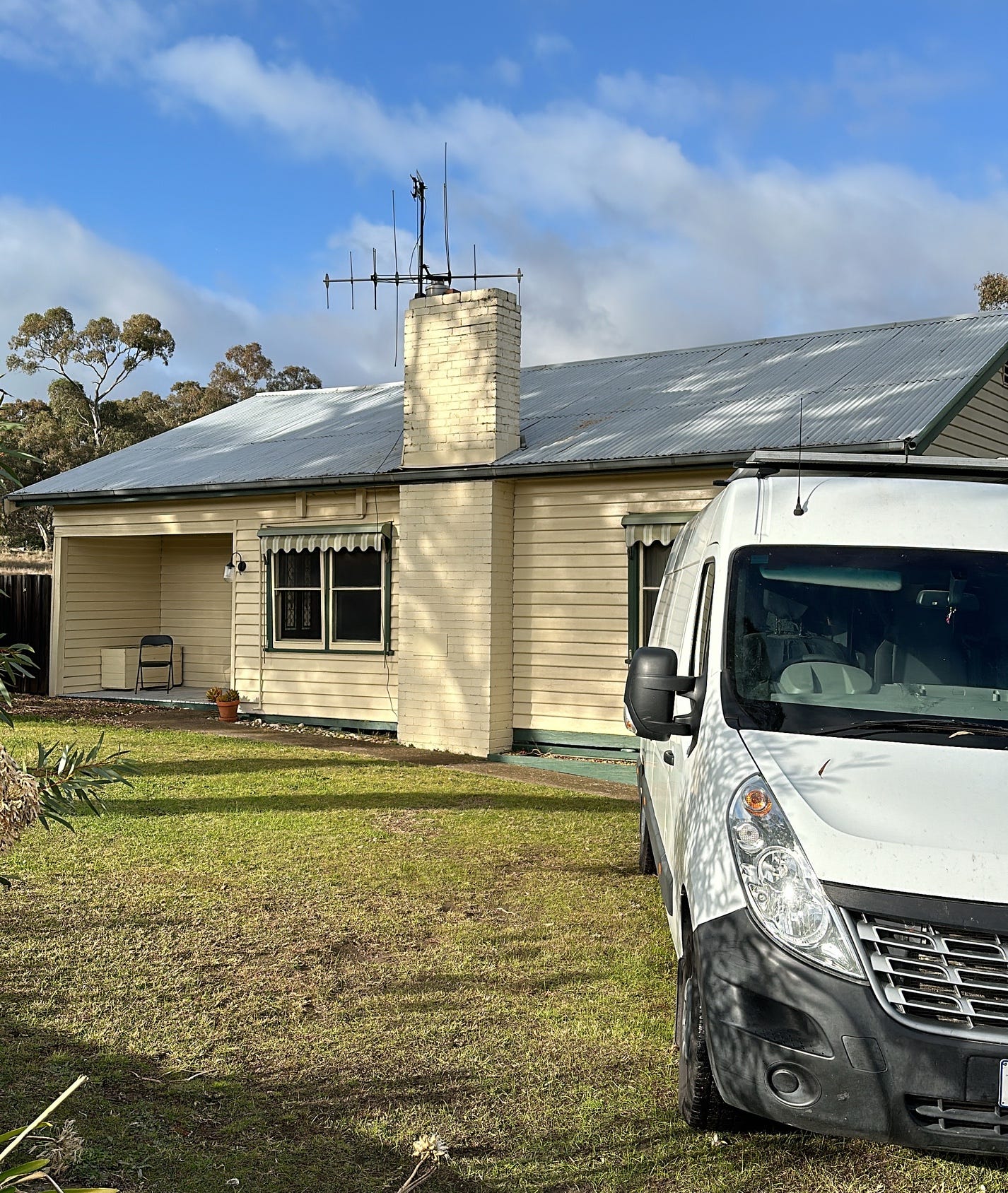
It was a nice weatherboard place on the southern edge of the town, probably built in the 1930s or 1940s, within easy walking-distance to the town’s now-disused railway station. There were a few other houses in front, on the northside, and along the road to the east, with the sportsground to the south, and the local pre-school and primary-school to the west. But on the other side, to the south-east, it was open country, paddocks and trees beyond - lovely to look out there from the rear verandah, sometimes seeing a mob of kangaroos bouncing around out there at the forest edge. Almost idyllic, in its way, if it hadn’t been only for the winter-time, and hadn’t been quite so cold!
The photo below is a view looking towards the south-east, showing the road-facing side of the house, with my trusty campervan-cum-moving-van parked out in front.
And I’d had good memories there - so after dropping off my friend at her place in Castlemaine, I took a detour to come through the south side of Harcourt, to see if all was well with my former home. I knew that the huge Coolstore opposite the old railway-station had been lost - along with the town’s entire fruit harvest, and decades of high-value vintage wines - and likewise the nice Coolstore Cafe beside it that I often used to walk to in the early mornings. But I’d been told that the sportsground and the schools, between that house and the Coolstore, had all survived intact, so I assumed that the same should apply to my old house too.
I was wrong.
The house was gone. All but erased.
All that remained were the fire-scorched brick chimney and fireplace, a few sections of half-melted steel roof-cladding, and a near-flat house-shaped pile of dull grey-white ash. Nothing else at all…
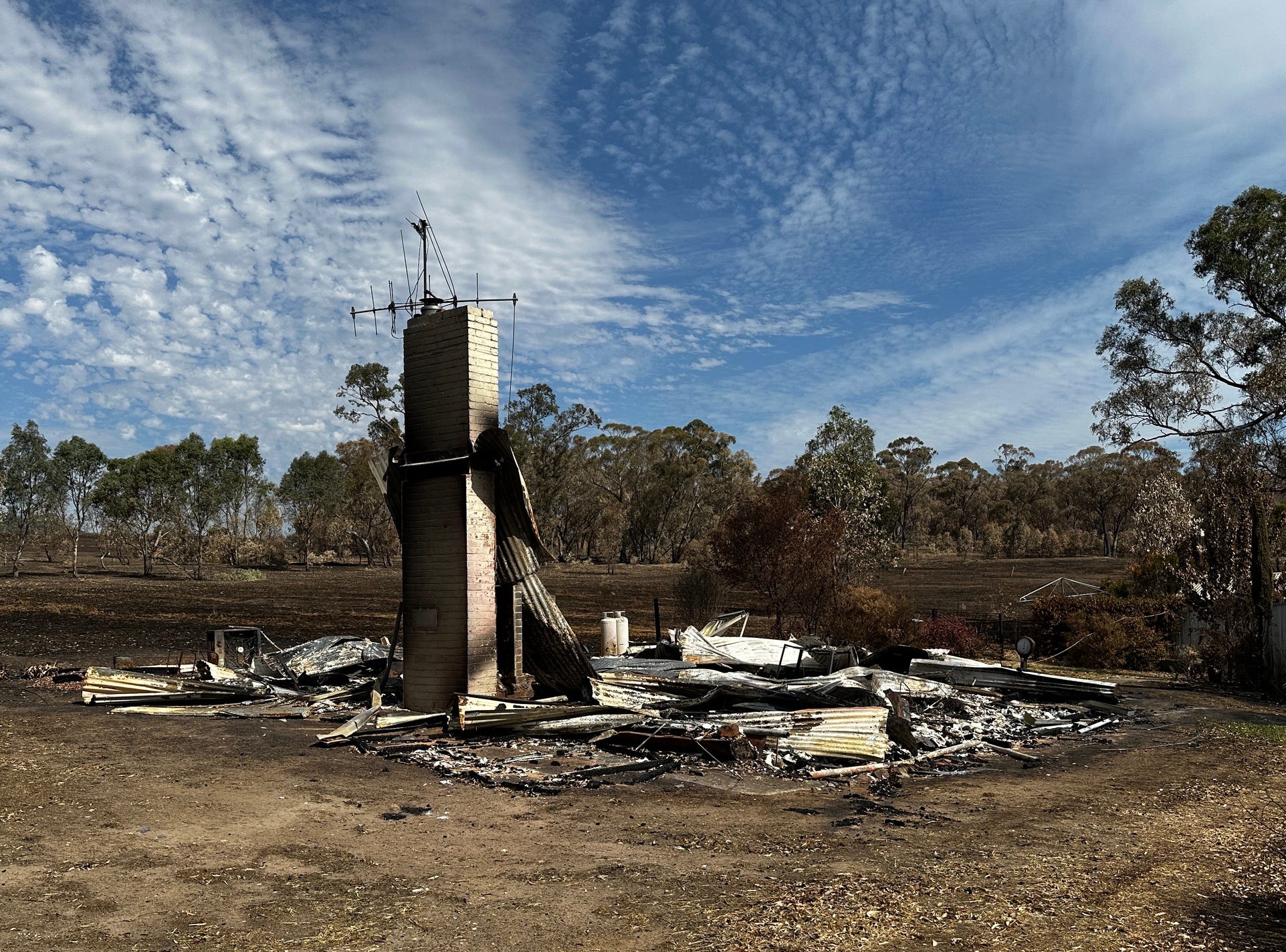
Not a small change…
What had happened? How had the fire hit just that one house, whilst everything around it seemed so unscathed?
Behind the Coolstore, the fire had been blocked at the sportsground by the bare berm of the seating-area to the west, and by the tarmac entry-road to the south. That fact had given the fire-crews enough space to be able to protect the schools. But to the south of the sportsground, the fire had ripped through the forest - as you’ll see in the background of that photo above - and then roared straight up the slight slope towards the house. Yet to cope with that same slope, the house had, as was so common at the time, been built on wooden stumps, with an open space underneath. When the fire reached the house, and hit the timbers of the verandah, that open space beneath had acted like the shaped inlet of a blast-furnace, sucking air in to feed the ever-hungrier flames. And once that process had started, the fate of the house was sealed: there was nothing that anyone could have done to save it. Nothing at all.
Nothing I can do to help either, right now. I know that no-one was hurt there, which is good - something to be grateful for, at least. There’s some chance, too, that there was no-one there at the time: I do know that the tenant who moved in after me had only taken a one-year lease, so with luck he’d moved out a month before the fires hit. That would have been good, if so. If not, all I can do is offer my condolences, and wish them well. Oh well…
Yet what if I had still been living there at that time? What would have happened, for me? That’s where this gets personal…
I would have survived: I’m pretty certain of that. If I’d followed the standard advice for a ‘Catastrophic Fire Danger’ day out here, I should have left in the morning, and been well out of the way by the time the fire hit in the late afternoon. If instead I’d stayed, even to the last minute, there would have still been two safe routes out of there, even on foot, to get to the relative safety of the village centre. At the house itself, the only way I would have been at risk would be if I’d tried to stay to fight the fire - and I don’t think that even I would have been foolish enough to risk that.
So if I wouldn’t have lost my life, what else might I have lost? A lot, is the short-answer: somewhere between ‘almost everything’ and ‘everything’….
What was at risk? It was only a stopgap rental while I found somewhere else to live, after all, so I hadn’t bothered to unpack all that much. For everyday living, I’d unpacked only a small selection of clothes and bedding, and the bare essentials for the kitchen and bathroom. In the bedroom that I used as an office, I had a couple of computers and support-equipment set up and ready for use, and also perhaps a dozen packing-boxes with the business-stuff that I might use during the stay. All of my other moving-boxes were still sealed and stacked up, filling almost the entire space of the other spare room.
So assuming I’d stayed at the house, what I’d lose would depend on how much warning I had. Slade said later that he received the ‘Evacuate’ warning around an hour after the firefront had passed them, so that’s a definite variable here.
If I’d had the wit to recognise the risk when the fire appeared several miles away on the state emergency-app at around 4:30pm, I would have had enough time to pack quite a lot into the van, as a precaution. The computers and essential-papers, certainly; perhaps all of those other boxes from the office; maybe even a few armfuls of clothes; but it’s doubtful I would have bothered to do anything more than that.
The reality, though, is that the speed, direction and ferocity of the fire caught everyone by surprise. Soon after it started, it rushed southward through the forest from its start-point, driven by a near gale-force wind. In less than half an hour, it had already jumped both the north-south freeway and the railway in several places, and was fast closing in onto the west side of the town. The burning roar and dense smoke would have been warning enough, of course, but it would also have been far from clear about where it was at each moment or where it might come from.
At best, in that scenario, I might have had as much as half an hour’s grace. Enough time get past the panic, perhaps, to get the essential boxes loaded into the van, and then get out of there as fast as I could.
But grass-fires can move at incredible speed: faster than a speeding car, at times. If I’d left it until I saw the flames burst out of the forest and into the paddock below the house, I would have had no more than a couple of minutes to make my escape before everything would burst into flames around me. If that were the case, I would only have had enough time to grab the van’s keys, perhaps grab a laptop from the office, but that would have been it.
If I’d set out in the morning, or if - as is quite likely, knowing me - I had instead gone to Slade’s place, thinking that the farm would have been at more risk than my own house and hence needed more protection, then I might have ensured that a laptop and maybe the essential papers were with me, as a ‘probably-unnecessary precaution’. Again, though, that would have been it.
Or, conversely, that would have been all that I’d have left in the world. Nothing else. All my furniture; all of my clothes; all of my books; all of my research-records from a lifetime of work. Look at that photograph above: everything still inside would have burned to ash along with the house itself. If I’d had to flee on foot, I wouldn’t even have been able to save the van.
Everything gone.
And yeah, I had no home-contents insurance back then - I couldn’t see any reason why I might need it….
So yeah, an uncomfortable exploration, that’s been - a very real ‘What if” or “What could have been”, if things in my life had been only a little bit different. “There but the grace of God” and all that.
A sobering experience, indeed…
It’s those sobering experiences that make you think how lucky you are and a small change can make a big difference. I vividly remember catching the same flight that flew into the Pentagon on 9/11 but a week before.
No good Tom - even a loss of short gained memories can be hard, esp when they're good ones